Interior Design and Wellbeing: Beyond Aesthetics

Karen Haller

What if the future of design isn’t about what looks good, but about what helps us live better?
It’s an interesting question, particularly when we consider how much our lives have changed. We’re constantly processing information, adapting to new technologies and dealing with the demands of everyday life.
So what does all of this mean for the homes, workplaces and other environments we spend our time in?
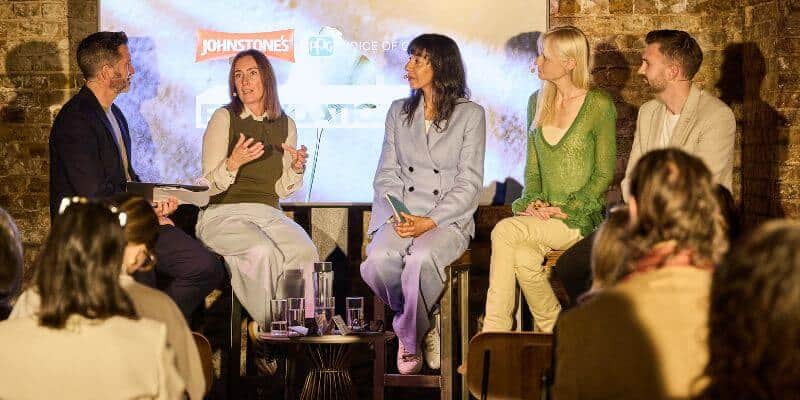
That was the wider conversation at Johnstone’s Trade’s 2027 Colour of the Year and colour forecast launch, where I was invited to join a panel discussion titled “The Antidote to Overstimulation: Creating Spaces That Support Modern Life.”
I was delighted to join Michelle Ogundehin (creative consultant, author and head judge of BBC’s Interior Design Masters), Ben Channon (architect and author) and Donna Taylor (Johnstone’s Trade Colour Design Manager), with Oliver Heath (biophilic designer and author) chairing the discussion.
And what an intelligent, thought-provoking conversation it was!.
Five perspectives on how design affects our lives
One of the things I particularly enjoyed about the discussion was hearing how we each approached this question from our different areas of expertise.
A few things have particularly stayed with me, starting with a question about something very close to home…
Why do we so often feel the need to leave home to rest and recover?
Michelle Ogundehin raised a point that I think will resonate with many people.
We book holidays, weekends away and spa breaks to escape the demands of everyday life. Yet our homes are the very places where we spend so much of our time. Michelle challenged us to consider how our environments affect our nervous system and whether our homes are giving us the sense of safety and restoration we need.
But there’s more to feeling at home than rest and recovery. There’s also the freedom to be ourselves.
Are we creating homes that reflect who we really are, or homes we think other people will approve of?
During the discussion, I spoke about our fundamental human need to belong and how our fear of judgement can influence the decisions we make.
Think about how easily we can be influenced by what others might think of our homes. We might love a particular colour or way of decorating, but hesitate because we’re worried someone else won’t like it.
Yet someone’s opinion of our home isn’t a judgement of who we are.
For me, this is such an important part of understanding our relationship with the spaces we inhabit. When we begin to recognise what’s influencing our choices, we can make decisions that better reflect who we are and how we want to live.
And it connects with something Ben Channon brought into the conversation.
What works for one person won’t necessarily work for another
Ben spoke about neurodiversity, accessibility and the importance of choice, particularly in shared environments.
It’s an important distinction. We can have the best intentions when designing for wellbeing, but if we assume everyone experiences an environment in the same way, we risk overlooking the very people we’re designing for.
How do we get the design brief right?
Donna Taylor spoke about her experience working with customers across healthcare, education, hospitality and social housing, and the importance of asking questions before making colour decisions.
She explained that her conversations begin with understanding the environment, including its existing finishes, natural light and how different spaces connect. For Donna, gathering that information is an essential part of understanding the brief and advising customers on their colour choices.
Are we making design decisions based on evidence or opinion?
Oliver Heath reinforced why evidence matters, rather than relying on opinions alone.
He made an interesting distinction between quantitative evidence, such as room temperature, acoustics and how frequently a space is used, and qualitative evidence, which comes from people’s personal experiences.
Someone might tell you they don’t enjoy spending time in a particular room, even if they can’t immediately explain why. That experience is worth exploring alongside the measurable factors.
Oliver’s point was that we need to examine our environments more analytically if we’re going to understand how they affect us and make better-informed design decisions.
The quote of the day
Perhaps the most memorable words of the discussion came from Michelle, who said:
“What surrounds you shapes you. Do not underestimate that.”
I immediately responded, “Well, that’s the quote of the day!”
Because that’s exactly why understanding the psychology of design matters. Our surroundings can influence how we think, feel and behave. So when we make decisions about colour and design, we need to consider not just how a space will look, but how it will affect the people who experience it.
For me, that’s where the real opportunity lies.
Not simply in creating beautiful spaces, but in understanding how design can make a meaningful difference to people’s lives.
And the conversations didn’t stop there!
It was great to catch up afterwards with my fellow panellists. Always lovely to see each other at industry events and have a chance for a chat.
I also love chatting with people who come up to me after the panel discussion. Hearing which ideas resonated, the questions they’re asking and their own experiences is one of my favourite parts of these events. It’s when the conversation takes on a whole new life!
It was also lovely to see former Interior Design Masters contestants there to support Michelle. Although I must admit I had a few “Have we met before…?” moments! 😂
A big thank you to Johnstone’s Trade for inviting me to be part of such a stimulating morning, bringing everyone together and treating us to a delicious breakfast!
I came away feeling encouraged by how the conversation around design is evolving. We’re asking deeper questions about people, behaviour and wellbeing, and recognising that how a space makes us feel and how it supports our lives matters just as much as how it looks.
And that’s a conversation I’m always happy to keep going.
Colourfully yours,
Karen
Image: courtesy of Johnstone trade